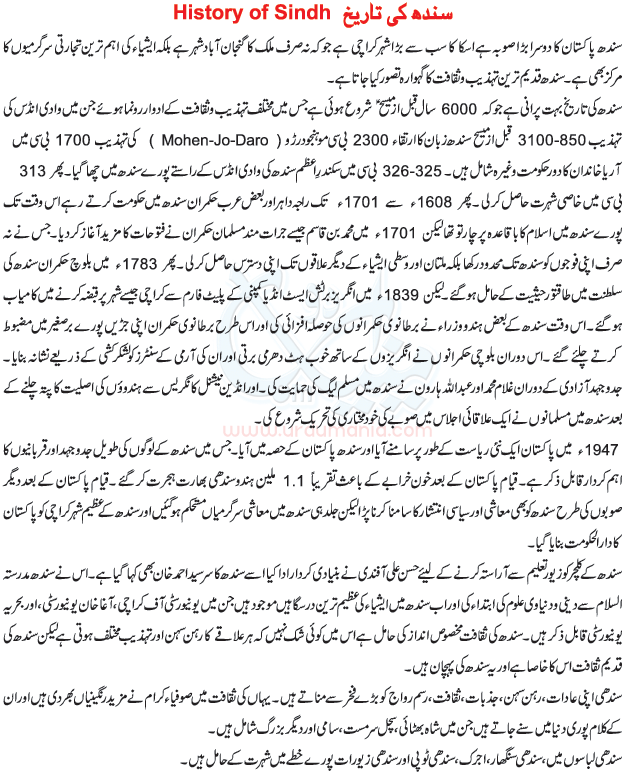
| | ORIGIN OF THE NAME The province of Sindh has been designated after the river Sindh (Indus) which literally created it and has been also its sole means of sustenance. However, the importance of the river and close phonetical resemblance in nomenclature would make one consider Sindhu as the probable origin of the name of Sindh. Later phonetical changes transformed Sindhu into Hindu in Pahlavi and into Hoddu in Hebrew. The Greeks (who conquered Sindh in 125 BC under the command of the Alexander the great) rendered it into Indos, hence modern Indus. PRE-HISTORIC PERIOD The Indus valley civilization is the farthest visible outpost of archeology in the abyss of prehistoric times. The areas constituting Pakistan have had a historical individuality of their own and Sindh is the most important among such areas. The prehistoric site of Kot Diji in Sindh has furnished information of high significance for the reconstruction of a connected story which pushes back the history of Pakistan by at least another 300 years, from about 2,500 BC. Evidence of a new element of pre-Harappan culture has been traced here. When the primitive village communities in Baluchistan were still struggling against a difficult highland environment, a highly cultured people were trying to assert themselves at Kot Diji one of the most developed urban civilization of the ancient world that flourished between the year 25,00 BC and 1,500 BC in the Indus valley sites of Moenjodaro and Harappa. The people were endowed with a high standard of art and craftsmanship and well-developed system of quasi-pictographic writing which despite ceaseless efforts still remains un-deciphered. The remarkable ruins of the beautifully planned Moenjodaro and Harappa towns, the brick buildings of the common people, roads, public-baths and the covered drainage system envisage the life of a community living happily in an organized manner. EARLY HISTORY The earliest authentic history of Sindh dates from the time when Alexander the Great abandoned his scheme of conquest towards the Ganges, alarmed at the discontent of his soldiers. He embarked a portion of the army in boats, floated them down the Jhelum and the Chenab, and marched the remainder on the banks of the river till he came to the Indus. There he constructed a fleet, which sailed along the coast towards the Persian Gulf with part of his forces, under the command of Nearchus and Ptolemy, whilst Alexander himself marched through Southern Baluchistan and Persia to Seistan or Susa. At that time Sindh was in the possession of the Hindus, the last of whose rulers was Raja Sahasi, whose race, as is reported by native historians, governed the kingdom for over two thousand years. The Persian monarchs were probably alluded to, for in the sixth century BC Sindh was invaded by them, They defeated and slew the monarch in a pitched battle and plundered the province and then left. Eight years after his accession to the Persian throne, Darius I, son of Hystaspes extended his authority as far as the Indus. This was about 513 BC. The Arab conquest of Sindh by Muhammad Bin Qasim in 712 AD gave the Muslims a firm foothold on the sub-continent. The description of Hiun Tsang, a Chinese historian, leaves no doubt that the social and economic restrictions inherent in the caste differentiations of Hindu society had however, gradually sapped the inner vitality of the social system and Sindh fell without much resistance before the Muslim armies. According to Al-Idreesi, the famous city of Al-Mansura was founded during the reign of Mansur (754-775 AD) the second Khalifa of the Abbasid dynasty. Khalifa Harun-al-Rashid (786-809 AD) was able to extend the frontiers of Sindh on its western side. For nearly two hundred years since its conquest by Muhammad Bin Qasim, Sindh remained an integral part of the Umayyad and the Abbasid caliphates. The provincial governors were appointed directly by the central government. History has preserved a record of some 37 of them. The Arab rule brought Sindh within the orbit of the Islamic civilization, Sindhi language was developed and written in the naskh script. Education became widely diffused and Sindhi scholars attained fame in the Muslim world. Agriculture and commerce progressed considerably. Ruins of Mansura, the medieval Arab capital of Sindh (11 kms south east of Shahdadpur) testify to the grandeur of the city and the development of urban life during this period. In the 10th century, native people replaced the Arab rule in Sindh. Samma and Soomra dynasties ruled Sindh for long. These dynasties produced some rulers who obtained fame due to judicious dispensation and good administration. Sindh was partially independent and the scene of great disorders till late in the sixteenth century when it failed into the hands of Emperor Akbar, and for a hundred and fifty years the chiefs paid tribute, but only as often as they were compelled to do so, to the Emperor at Delhi. Later the Kalhora clan claiming descent from the house of Abbas and long settled in Sindh produced religious leaders of whom Main Adam Shah attained prominence in the 16th century. His descendants continued to gather large following and this enabled them to capture political power in the north western Sindh under the leadership of Mian Nasir Muhammad. This happened in the 2nd half of the 17th century. By the turn of that century, foundations of the Kalhora power were firmly laid in the northern Sindh under the leadership of Mian Yar Mohammad. During the reign of his son, Mian Noor Muhammad, lower Sindh with Thatta as its capital came under the Kalhora administration (1150 A.H). Under the banner of Mir Fateh Ali Khan Talpur, the Balochis defeated the last Kalhora ruler Mian Abdul Nabi in the battle of Halani in 1782 AD. Talpur Amirs regained the parts of Sindh (Karachi, Khairpur, Sabzal Kot and Umar Kot) which the last Kalhora chief had conceded to the neighboring rulers. By eliminating the foreign interference, which had plagued the Kalhora rule, and by their essentially democratic way of governance, the Talpurs were able to take the people into confidence and thus achieved Great many things within a short period of 60 years. They built up an excellent system of forts and outposts guarding the frontiers, extended the irrigation system, encouraged scholarly pursuits and educational institutions, and promoted trade and commerce internally as well as with the neighboring countries. The British who came to Sindh also as traders became so powerful in rest of the sub-continent that in 1843 Sindh lost its independence falling prey to the British imperialistic policy. The Talpurs were defeated on the battlefields of Miani, Dubba and Kunhera and taken prisoners. The conquerors behaved inhumanly with the vanquished as they did with the Muslim rulers in India. Charles Napier who commanded the troops subsequently became the first Governor of the province of Sindh. The British had conquered Sindh from their bases in Bombay and Kutch and their supporters were Hindus. Therefore, Sindh was annexed to the Bombay Presidency in 1843 and a constant policy to subdue the Muslim majority and to lionize the Hindu minority in Sindh was followed. Trade and commerce, Services and education became monopolies in the hands of the minority whom with the support of the rulers wrought havoc on Muslims. Within a few years forty percent of the Muslim land holdings passed on to the Hindu creditors. It was after a long struggle that the cause of Sindh was supported by the Quaid-e-Azam Mohammad Ali Jinnah when he brought in his famous 14-points the demand of Sindh's separation from Bombay Presidency. H.H. Sir Agh Khan, G.M. Syed, Sir Abdul Qayyum Khan (NWFP) and many other Indian Muslim leaders also played their pivotal rule that was why the Muslims of Sindh succeeded in getting Sindh separated from the Bombay Presidency in 1936. |
The mound of Amri is located along the right bank of the Indus River, south of Dadu. The excavations carried out by the French Archaeological Mission at the beginning of the sixties revealed a long sequence of subsequent habitation phases datable from the Copper to the Bronze Age. The typical Amri layers have been radiocarbon-dated to the second half of the fourth millennium BC and are attributed by some authors to the beginning of the Early Harappan Civilization. At least 160 settlements attributed to the Amri Culture, among them the Tharro Hills, near the village of Gujo, is one of the most famous of lower Sindh. .. The site of Kot Diji, near Rohri, consists of a small mound composed of a sequence of overimposed structures and anthropogenic layers. They have been subdivided into two main complexes, the first of which belongs to the Early Harappan, Kot Diji Culture, and the second to the Mature Harappan Civilization. The site of Lakhueen-jo-daro, near Sukkur, belongs to the Mature Harappan Civilization as indicated by the characteristics of the structural remains, material culture finds and one radiocarbon date, covers a wide area, from which a few mounds emerge. The site indicates that the origins of Sukkur are to be referred to a much older period than previously suspected. The metropolis of Mohenjo-daro, near Larkana, is largest Indus city so far discovered in Sindh. The large-scale excavations carried out in the 1920s brought to light most of the architectural remains that are still currently visible. They are mainly of backed bricks with very well preserved buildings aligned along streets and lanes. Mohen-jo-daro is the largest Bronze Age city of the world. The larkana was very famous city in sindh. moen-jo-dero is 25 kilometer far from larkana.ratodero is 30 kilometer far from larkana ratodero is very big city and very famous ratodero is name of rato jalbani he was very brave and honest. he was very rich in sindh now he was dead now her tomb in 10 meter in the gold he does not give her gold to her sons,and her son was sobdar khan jalbani there was the famous story of the sindh. Pir Shah Jurio is a Mature Indus Civilization village along the left bank of the Hub River. It consists of a small mound, which is nowadays partly covered by a cemetery. From its surface, typical potsherds and other finds were collected. This site is strictly connected with the sea, which is a few kilometers south of it. It was radiocarbon-dated to the third millennium BP, from a sample of Terebralia palustris shells. The Indus Civilization site of Kot Bala is located in the interior of the Sonmiani Bay, along the coast of Lasbela District, Balochistan. It was partly excavated by Professor G. Dales of Berkeley University in the Seventies and never published in detail. This site is of great importance for its location close to the Arabian Sea. It is supposed to be one of the main harbors from which the Indus traders sailed their ships to the coasts of the Arabian Peninsula. Sindh has been known by various names in the past, the name Sindh comes from the Indo-Aryans. In Sanskrit, the province was called Sindhumeaning the river Sindh and the people living on its banks. The Assyrians (as early as the seventh century BCE) knew the region as Sinda, thePersians Hindush, the Greeks Indos, the Romans Sindus or Indus, the Chinese Sintu, while the Arabs dubbed it Sind. A legend claims that theIndus River flowed from the mouth of a lion or Sinh-ka-bab. [edit]Ancient eraIn ancient times, the territory of the modern Sindh province was sometimes known as Sovira (or Souveera, Sauvīra) and also as Sindhudesha, Sindhu being the original name for Indus river and the suffix 'desh' roughly corresponding to country or territory. The first known village settlements date as far back as 7000 BCE. Permanent settlements at Mehrgarh to the west expanded into Sindh. One of the original inhabitants of ancient Sindh were the Austro-Asiatic speaking peoples who spoke the Munda languages. This culture blossomed over several millennia and gave rise to the Indus Valley Civilization around 3000 BCE. The Indus Valley Civilization spanned much of what is today Pakistan, but went into decline a few centuries prior to the invasion of the Indo-Aryans which is still a hotly debated subject, a branch of the Indo-Iranians, who are considered to have founded the Vedic Civilization, that existed between the Kabul river, the Sarasvati River and the upper Ganges river after 1500 BCE. The Vedic civilization - with much in-fighting and fighting with the locals as well as interaction with them - ultimately helped shape subsequent cultures in South Asia. Another group of academia, claims that the original inhabitants of Sindh, who gave rise to the Indus Valley Civilization around 3000 BCE, werenative Aryans, as Vedic literature speaks of no reference to an Aryan race outside of the South Asia. This topic is considered still unresolved. The Indus Valley Civilization rivaled the contemporary civilizations of Ancient Egypt and Mesopotamia in both size and scope numbering nearly half a million inhabitants at its height with well-planned grid cities and sewer systems. It is known that the Indus Valley Civilization traded with ancient Mesopotamia and ancient Egypt via established shipping lanes. In ancient Egypt, the word for cotton was Sindh denoting that the bulk of that civilizations cotton was predominantly imported from the Indus Valley Civilization. Speculation remains as to how and why the civilization declined and may have been a combination of natural disasters such as deterioration in climate, flooding as well as breakdown of international trade and internecine conflicts. Sindh was conquered by the Persian Achaemenid Empire in the late 6th century BCE, and became a the Persian satrapy (province) of Hindushin addition to that of Gandara (Gandāra) centered in the Punjab to the north. Iranian and thus also Persian speech replaces 'S' with 'H' in manySanskritic words, resulting in 'Sindhu' being pronounced and written as 'Hindu'. They introduced the Kharoshti script and links to the west in the region. Conquered by Macedonian Greek armies led by Alexander the Great, after 326 BCE the region came under loose Greek control for a few decades. After Alexander's death, there was a brief period of Seleucid rule. Sindh was conquered by the Mauryan Empire of Chandragupta after a peace treaty ended the Seleucid–Mauryan war in 303 BCE. Later, during the reign of the emperor Ashoka the region would solidly become a Buddhist domain. Following a century of Mauryan rule which ended by 232 BCE, the region came under the Greco-Bactrians based in what is today northern Afghanistan. Some of their rulers also converted to Buddhism and spread it in the region. The Scythians (Saka) shattered the Greco-Bactrian kingdom. Subsequently, the Tocharian Kushan Empire annexed Sindh by the 1st century CE. Though the Kushans followed their own religion, they were tolerant of the local Buddhist tradition and sponsored many building projects for local beliefs. Scythians, Kushans, Huns and the Sassanid Persians all exercised some degree of control in Sindh until the coming of the Muslim Arabs in 711 CE. The Buddhist city of Siraj-ji-Takri is located along the western limestone terraces of the Rohri Hills in the Khairpur district of Upper Sindh, along the road that leads to Sorah. Its ruins are still visible on the top of three different mesas, in the form of stone and mud-brick walls and small mounds, whilst other architectural remains were observed along the slopes of the hills in the 1980s. This city is not mentioned from any text dealing with the history of the Buddhist period of Sindh. [edit]References in ancient literatureThe Vedas (Rigveda) praises the Sindhu, the cradle of civilization. "Sindhu in might surpasses all the streams that flow.... His roar is lifted up to heaven above the earth; he puts forth endless vigour with a flash of light .... Even as cows with milk rush to their calves, so other rivers roar into the Sindhu. As a warrior-king leads other warriors, so does Sindhu lead other rivers.... Rich in good steeds is Sindhu, rich in gold, nobly fashioned, rich in ample wealth." In this hymn Sindhu, unlike other rivers, is considered masculine. Other references are, when the Vedic seer invokes heaven and earth, he also invokes the Sindhu. The Veda refers to the Ganges only twice; but it makes as many as thirty references to the Sindhu. This is the Great Sindhu that gave Sindh its name. In Ramayana Sindh was part of Dasaratha's empire. When Kekayi goes into a sulk, Dasaratha tells her: "The sun does not set on my empire. Sindh, Sauvira, Saurashtra, Anga, Vanga, Magadha, Kashi, Koshal --- they are all mine. They produce an infinite variety of valuable articles. You can ask whatever you like." Of course Kekayi wants nothing short of the throne for her son, Bharata. The rest is epic history. When Sita was kidnapped by Ravana, Rama sent the vanaras(monkeys) to look for her, among other places, in Sindh with its "remarkable swimming horses." Later, when all ended well, Rama gave Sindhu-Sauvira (the Sindh and Multan areas) to Bharata, who duly extended his rule farther north to Gandhara, the home town of Gandhari of Mahabharata fame, which is the modern-day Afghan city Kandahar. His sons founded the cities ofPeshawar (Pushkalavati) and Taxila (Takshasila). Sindh is also mentioned in the Mahabharata. King Jayadratha of Sindh was married to Kaurava prince Duryodhan's sister, Dushhala. He was, therefore, all along on the side of the Kauravas and against the Pandavas. However, be it said to the credit of Jayadratha that he, like Dhritarashtra and Bhishma, opposed the disastrous game of dice between the Pandavas and the Kauravas. In the titanic battle of Mahabharata, when Abhimanyu, Subhadra's son, got killed, Jayadratha "pushed his body with his foot. Arjuna was furious. He vowed to kill "Sindhu-Pati" Jayadratha that very day, before the sun set. Jayadratha wanted to flee the field, but it was too late. He died an inglorious death. Jayadratha's other love was milk and condensed hot milk (the Sindhi khirni). When announcing his determination to kill Jayadratha, Arjuna said: "Jayadratha is a relation, but he is evil; he has been brought up on kshir and kshirni, but now I'll cut him to pieces with my arrows." In the Bhishma Parva of the Mahabharata, the Sindhu is referred to as the great protector which must be remembered day and night. Obviously the mighty river was a mighty defence line of the country. The Anushasana Parvan of the Mahabharata prescribes bathing in Sindhu river to go to heaven after death, signifying its purity. Interestingly enough, the Bhagvad Gita is based on an earlier sermon involving Sindh! Once upon a time, the king of Sindh had defeated young prince Sanjay of Sauvira. Sanjay had lost heart and wanted to forget all about his kingdom. But his brave mother Vidula had shamed him into action. She had told him to remember his ancestry, remember his responsibilities to his people, uphold dharma, and live nobly or die nobly. At a time when the Pandavas were dispirited and did not want to fight, their mother Kunti reminded Krishna of the story of Vidula and asked him to repeat it to her sons—to move them to action. The result was the immortal sermon of the Gita. Dushhala also did a great good turn to Sindh. Since the movement of the centre of Indian civilization from the Sindhu to the Ganges, the former had obviously become a rough frontier tract subject to frequent invasions. Dushhala was pained to find the tribes of Jats and Medes in Sindh quarrelling endlessly. She therefore requested Duryodhana to send some Brahmins to tone up the socio-cultural life of Sindh. Duryodhana was good enough to send 30,000 Brahmins to Sindh. It was these Brahmins who later formed the backbone of resistance to Alexander. But of that, later. Kalidasa says in the Raghuvamsha that on the advice of his maternal uncle Yudhajat, Rama conferred Sindh on Bharata. Rama's ancestor Raghu's triumphant horses had relaxed on the banks of the Sindhu. Another great Sanskrit poet, Bhasa, had created a play titled Avimarkabased on the romance of prince Avimarka with princess Kurangadi of Sindhu-Sauvira. The Bhavishya Purana says that Shalivahana, the grandson of Maharaja Vikramaditya of Ujjain, established law and order in "Sindhusthana" and fixed his frontier on the Sindhu. Anshnath, the eleventh Jain Tirthankar, was a Sindhi. He died in Bengal. The Jaina Dakshinyachihna (eighth century) speaks of the Sindhis as "elegant, with a lovely, soft and slow gait. They are fond of songs, music and dance and feel affection for their country." There is a legend that the great Buddha had graced Sindh with his visit. Finding the climate extreme, and the area dry and dusty, he had permitted the bhikshus to wear shoes here. He had also permitted the use of padded clothing, forbidden elsewhere. Here Sthavirtis, the prince of Rorik or Roruka (Aror or Alor near modern Rohri) became his disciple. When the Buddha went round his native Kapilavastu in a chariot, it was mentioned that the "four auspicious horses, of lotus colour, had come from Sindhudesha." To this day, historic Buddhist stupas are found in Sindh. No wonder when Zulfikar Ali Bhutto had become head of Pakistan, even he adorned his office with a statue of the Buddha. The Divyavadana (Tibetan version) reports: "The Buddha is in Rajagriha. At this time there were two great cities in Jambudvipa (India): Pataliputra and Roruka. When Roruka rises, Pataliputra declines; when Pataliputra rises, Roruka declines." Here was Roruka of Sindh competing with the capital of the Magadha empire. When Bimbisara was king of Magadha, he sent Rudrayana, king of Sindhu-Sauvira, a rare portrait of the Buddha. The two powerful ministers of Sindh at the time were Hiroo and Bheru, their names still common among the Sindhis. Chandragupta Maurya first won Sindh and the Punjab. It was from this base that he displaced the Nandas, occupied Pataliputra and established the great Mauryan empire. Kashmir's ancient royal history Rajatarangini has many references to Sindh. Kuya's son Sindhu rose to lead the elephant brigade of Kashmir and became an adviser to Queen Didda. A top honour in Kashmir was "Sindhu Gaja", Elephant of Sindh. [1] Sindh was ruled by Rai Dynasty during c. 489–632. Rai Diwaji (Devaditya) was the greatest ruler of this dynasty, who stands out as a great patron of Buddhism, comparable to Ashoka in this regard. The capital of his vast empire was Al-ror. The empire was usurped later by Brahman dynasties, whose unpopularitiy was a contributing factor to later Arab conquest. [edit]Rajput DynastiesRai Dynasty of Rajputs was the ruling dynasty of Sindh from c. 489 – 632. The Rais were one of the Middle kingdoms of India and patrons ofBuddhism even though they also established a huge temple of Shiva in present-day Sukkur, derived from original Shankar, close to their capital in Al-ror.[1] This is consistent with the historical accounts from the times of Emperor Ashoka and Harsha because Indian monarchs never sponsored a state religion and usually patronized more than one faith. The influence of the Rai state to Kannauj in the east, Makran and Debal (Karachi) port in the west, Surat port in south, Kandahar, Sistan, Suleyman, Ferdan and Kikanan hills in the north. [edit]Harsvardhan ruleHarsvardhan ruled in Sindh from 600 to 647 AD. [edit]Islamic era[edit]During the Rashidun Caliphate Sindh in 700 AD, under the Brahmin dynasty. The province of Sistan was the largest province of Persian Empire; its frontiers extended from Sindhin east to Balkh (Afghanistan) in north east.[2] During the Rashidun Caliphate, the Islamic conquest of some parts of Sindh was extension of the campaigns to conquer the Persian empire in 643 AD, by sending seven armies from seven different routs to different parts of empire. Islamic forces first entered Sindh during the reign of Caliph Umar, in 644] AD. It was not a full scale arrival in Sindh, but was merely as extension of the conquests of the largest province of Persia - Sistan and Makranregion. In 644 AD, the columns of Hakam ibn Amr, Shahab ibn Makharaq and Abdullah ibn Utbanconcentrated near the west bank of Indus river and defeated the army of Raja Sahasi Rai II a Hinduking of Rai kingdom of Sind, in Battle of Rasil, his armies retreated to the estern bank of river Indus. In response of Caliph Umar's question about the Makran region, the Messenger from Makran answered: - 'O Commander of the faithful!
- It's a land where the plains are stony;
- Where water is scanty;
- Where the fruits are unsavory;
- Where men are known for treachery;
- Where plenty is unknown;
- Where virtue is held of little account;
- And where evil is dominant;
- A large army is less for there;
- And a less army is use-less there;
- The land beyond it, is even worst. [referring to Sind]
Caliph Umar looked at the messenger and said: "Are you a messenger or a poet?" He replied, "Messenger". Thereupon Caliph Umar, after listening to the unfavorable situations for sending an army, instructed Hakim bin Amr al Taghlabi that, for the time being, Makran should be the easternmost frontier of the Islamic empire, and that no further attempt should be made to extend the conquests. After the death of Caliph Umar the areas—like other regions of Persian Empire—broke into revolt and Caliph Uthman sent forces to re-conquer them. Caliph Uthman also sent his agent Haheem ibn Jabla Abdi to investigate the matters of Hind. On his return, he told Caliph Uthman about the cities and, listening to the miserable conditions of the region, he avoided campaigning in interior Sindh and, like Caliph Umar, he ordered his armies not to cross Indus river.[3] [edit]Under the Umayyads, Abbasids and later dynasties coins during the rule of Amirs of Sindh , c. 257 -- 421 AH / c. 870 -- 1030 AD Sindh was finally conquered by Syrian Arabs led by Muhammad bin Qasim; it became the easternmost province of the Umayyad Caliphate. The Arab province of Sindh is modern Pakistan, while the lands of modern India further east were known to the Arabs as Hind. The defeat of the Hindu ruler Dahir Rajahwas made easier due to the tension between the Buddhist majority and the ruling Hindus' fragile base of control. The Arabs redefined the region and adopted the term budd to refer to the numerous Buddhist idols they encountered, a word that remains in use today. The city of Mansura was established as a regional capital and Arab rule lasted for nearly 3 centuries and a fusion of cultures produced much of what is today modern Sindhi society. Arab geographers, historians and travellers also sometimes called the entire area from the Arabian Sea to the Hindu Kush as Sindh. The meaning of the word Sindhu being water (or ocean) appears to refer to the Indus river. Mahmud Ghaznavi conquered the area by 977 CE by defeating the Habbari dynasty which was the Ummayad caliphate's entity in the region ruling semi-independently. TheUmmayad rule ended with the ascension of the Soomra Dynasty which was Abbasid caliphate's functionary in sindh from 1024 to 1258. since Then Soomra Dynasty continued to rule independently for a further 100 years but were forced to defend their land by Sultans of Delhi wanting a piece until finally losing to the might of their armies. The Mughals also tried to take control of the region but their efforts were challenged by the Samma Dynasty from their base at Thatta. The Muslim Sufis played a pivotal role in converting the millions of native people to Islam. Sindh then became a part of larger empires as a loyal Muslim domain and came under the rule of the Arghun Dynasty and Tarkhan dynasty from 1519 to 1625 and then the Durrani Empire by 1747. The Talpur's then established government in Sindh from 1783 and they remained the ruling elite with their capital in Khairpur until Sir Charles James Napier ended their reign.[4] [edit]Colonial eraThe British East India Company started its occupation of Sindh at the time when it was ruled by Balochi tribesmen of Dera Ghazi Khan. Most of them were Talpur (a branch of Laghari tribe), Laghari, Nizamani, Murree, Gopang and other Balochi tribesmen. Karachi was the first area in the province to be occupied by the British East India Company in 1839. Four years later, most of the province (except for the State of Khairpur) was added to the Company's domain after victories at Miani and Dubbo. Many people helped the British in the conquest of Sindh, including a Hindu government minister of Sindh, Mirs of Khairpur, Chandio Tribesmen, and Khosa Tribesmen. General Charles Napier is said to have reported victory to his Governor General with a Latin one-word telegram, namely "Peccavi" – or "I have sinned (Sindh)"', which is a pun. Charles Napier had brought first army consisting of mostly Bengali soldiers. The Balochi ruling forces of Sindh used to attack the British led armies in the darkness of night. The Bengali soldiers could not compete in those war techniques, and they used to run away. Then, Charles Napier hired Khosa Baloch tribesman (from Dera Ghazi Khan) in his army, to fight with the ruling Balochis of Sindh, who were also originally from Dera Ghazi Khan, Punjab. Chandio Baloch Sardar brought a cavalry of 10,000 to support Charles Napier in the Miani war, but did not participate in the actual war, and his armies stood on reserve to attack in case Charles Napier lost the war. For his role, Chandio sardar got Chandka (present day Larakana, Qambar-Shahdadkot districts) as Jagir. Talpurs of Khairpur also got Khairpur state as gift from Charles Napier for non-participation in the war. The first Aga Khan had helped the British in the conquest of Sindh and was granted a pension as a result. Sind was made part of British India's Bombay Presidency in 1847 and became a separate province in 1936.[5] During British control of Indian subcontinent, they laid railway lines in Sindh. Many barrages and canals were built to irrigate farm land in Sindh, which improved the livelihood of rural Sindhis. The first stamps in Asia, known as Scinde Dawk, were released in 1852. The mail was carried quickly and efficiently, connecting British administrative offices and post offices from Karachi through Kotri and Hyderabad up to Shikkur in the north. During the freedom struggle, the Sindh branch of Muslim League party was established by Ghulam Muhammad Bhurgari in 1918. Abdullah Haroon, who joined it in 1918, was elected president of the provincial Muslim League in 1920. In those days, both the Muslim League and the Indian National Congress of Sindh held their annual sessions at the same place simultaneously and passed similar resolutions. The Sindh assembly was the first British Indian legislature to pass the resolution in favour of Pakistan. G. M. Syed, an influential Sindhi activist, revolutionary, and one of the important leaders in the forefront of the provincial autonomy movement, joined the Muslim League in 1938 and presented the Pakistan resolution in the Sindh Assembly. [edit]IndependenceOn August 14, 1947 Pakistan gained independence from foreign British colonial rule. The province of Sindh thus regained its self rule, lost since the defeat of Sindhi Talpur Amirs in the Battle of Miani on February 17, 1843. The first challenge faced by the Government of Sindh was the settlement of Muslim refugees. Nearly 7 million Muslims from India migrated to Pakistan while nearly equal number of Hindus and Sikhs from Pakistan migrated to India. The Muslim refugees, (known as Muhajirs from India), settled mostly in urban areas of Sindh, most of them in Karachi and Hyderabad. [edit]EducationThe foundation for modern, liberal, universal education was laid by the British colonial administration. Sindhi intelligentsia also participated in this modernisation of educational system. Hassan Ali Affandi, maternal grandfather of the present President of Pakistan (Mr. Asif Ali Zardari), can be regarded as Sir Syed Ahmed Khan of Sindh. He made great efforts to encourage the Sindhi people to get modern education. He built an educational institution known as Sindh-Madrsat-ul-Islam. Muhammad Ali Jinnah went to Sindh-Madarsat-ul-Islam in Karachi, Sindh for education and, after his law education, worked in Karachi for a Sindhi (Hindu) law firm. Education in Sindh is divided into five levels: primary (grades one through five); middle (grades six through eight); high (grades nine and ten, leading to the Secondary School Certificate); intermediate (grades eleven and twelve, leading to a Higher Secondary School Certificate); anduniversity programs leading to graduate and advanced degrees. Primary, middle and high schools are established in all parts of Sindh providing, Sindhi, Urdu and English medium schools. The colleges and universities are established in major towns and cities of Sindh. They provide courses leading to BA, BSc and Bachelor of Commerce / BCom/BBA degrees. medical colleges and engineering colleges are also established in major cities of Sindh. There are many postgraduate and research institutes in Sindh providing state-of-the-art education to Sindhi students. [edit]EconomySindh has become the most industrialized and urbanized province of Pakistan. The head offices of Pakistani companies, and regional offices of international companies, are located in Sindh. The Sindhis have been in forefront of economic development of the province. The new dams and canals have irrgated many areas that were barren and Sindh produces many agricultural products for the country and for export. The construction of multi-billion projects like Karachi Nuclear Power Plant, Port Qasim and Pakistan Steel Mills provided tens of thousands of jobs to the residents of Sindh. [edit]PoliticsThe founding father of Pakistan, Quaid-e-Azam Muhammad Ali Jinnah was of Sindhi background. Khan Bahadur Muhammad Ayub Khuhro was the first Chief Minister of Sindh, after independence of Pakistan. Pakistan's political scene continued to be dominated by Sindhi politicians likeZulfikar Ali Bhutto, Mumtaz Bhutto, Benazir Bhutto, Muhammad Khan Junejo, Ghulam Mustafa Jatoi, Asif Ali Zardari, Muhammad Mian Soomro, who served the nation as President, Prime Minister, Senate chairman etc. Karachi was chosen as the first capital of Pakistan and it remains now as the capital of Sindh province. In the province of Sindh, the Sindhis have always dominated the government and its various departments. [edit]See also[edit]External links[edit]References |